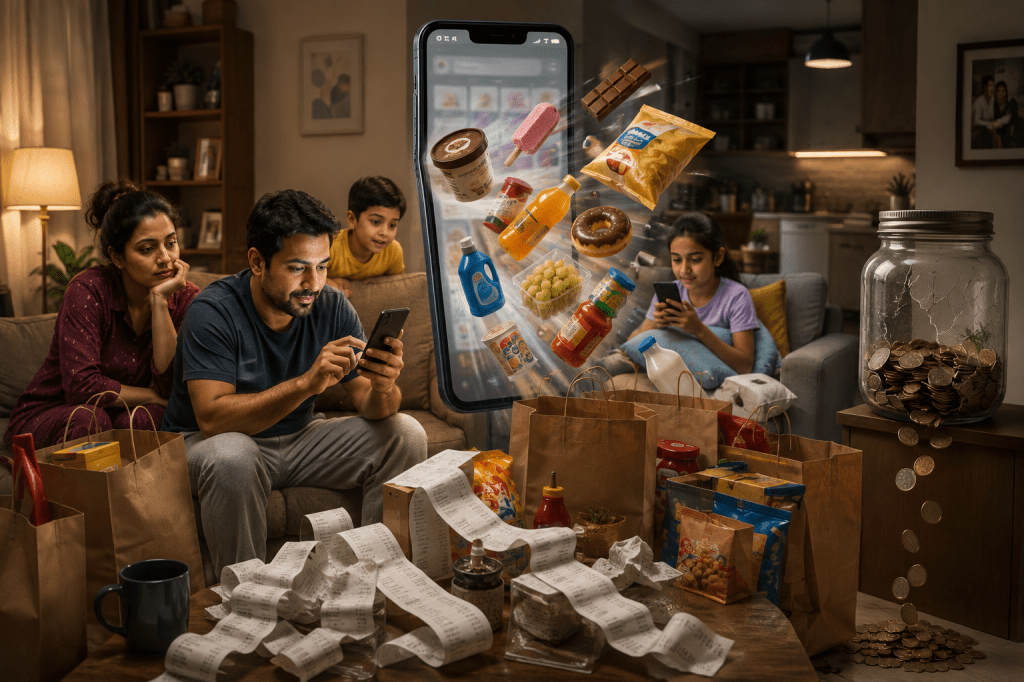
“We will wait .” This is how middle class family resist the urge for compulsive shopping . This Waiting period allows the family to evaluate their options and reasoning before buying anything . Forgot to buy it ? “we will wait for the next time .” Very expensive ? ” We will wait till the price drops .” But now with the introduction and spreading of the Quick Commerce companies providing goods within 10 minute of delivery , the waiting period has vanished . Compulsive shopping has taken over .
Let us know how these Quick Commerce Companies have changed the philosophy of middle class shopping –
- Small Purchases Stop Feeling Like Real Spending
Little drops make a mighty ocean . The Middle Class Families build their savings in similar fashion , adding small daily savings through out the year . Earlier , if they had craving for an ice cream , they don’t just get it , they always make an attempt to control their craving knowing that it may save that ₹25 that they were initially going to spend .
With the introduction of quick commerce . The same ₹25 ice cream is sold to them for ₹40, the additional ₹15 does not feel like a large amount ,considering the ease at which the purchase was made . A single order of ₹40 item may seem insignificant , but when similar expenses are repeated through out the month , often become a big part of the household budget , which sometimes go unnoticed because of its miscellaneous nature .
Also check out : Why Middle Class Parents don’t invest in their Child’s nutrition
- Discounts turn saving into overconsumption
Imagine there is a product being sold at ₹180 , On that app the price would be displayed as ₹200 , with ₹200 is crossed out and selling price is showed as ₹180 . The customer sees a ₹20 discount but in reality they are buying it at its cost price with 0% discount . The final price may even rise further because of the convenience charges , platform charges etc .So, the discounted product at ₹180 would actually cost more than ₹190 .
This discount is very effective for the quick commerce companies as it leads to increase in sales . The people buy it even if they don’t need it at that time thinking the price would increase again in future or if the offer would not come back again . Rather than saving money they get trapped by these discount traps . This behaviour when repeated over a long period of time would only lead to over consumption and a realization – converting the feeling of “Today I saved ₹20 .” into the reality of “I spent ₹200 on a thing which i never really needed.”
- Quick commerce monetizes poor planning
Before Quick commerce companies were a thing , poor planning always came with inconvenience for the middle class families . If you had miscalculated or forgotten an ingredient , you had to do the grocery run again , adjust your plan or do something similar with whatever was available at your home . Quick commerce somehow changed the entire equation .
Anything you forgot to purchase from the market could be at your doorstep within 10 minutes , whatever you crave would be fulfilled within minutes . This removes the need of inventory management in your home. Hence , instead of checking and evaluating your existing storage , you just order that product right off from the app.
Each forgotten item becomes a new purchase trigger . Only when you open your storage closet , you notice that you already have the same product lying there for months but has also expired . So we are not only over consuming products but also wasting it .
Also check out : Why you should stop waiting for a higher salary before starting to invest
- Convenience Premium Hits the Most Price-Sensitive Consumers
The biggest irony of quick commerce is that it makes the most most price sensitive shoppers to go for the easiest option . Earlier , the middle class families used to travel to various markets to compare prices before buying a ₹500 product ,or at least wait for some sale .
But, when the same item comes to your home just upon a click , you often wonder convenience is much better than the discount. That ₹20 discount no longer matters. The amount may look small , but the danger lies in the repetition . Upon repetition , this convenience becomes a recurring expense .
Slowly , the middle class families have shifted their value system from savings to convenience . The quick commerce companies changed their philosophy of middle class shopping from “ Where can i get this cheaper ?” to “How quickly can i get this ?”
- People Lose Track of Where the Grocery Budget Goes
Earlier , a middle class family would carry out a single grocery run as per its monthly budget in a single transaction . Now , with the introduction of Quick Commerce services , the groceries can be bought in dozens of transactions spanning every member of the family .
Each member would buy things at their own will and convenience . The grocery budget no longer is a visible decision to buy the ration . A singular decision and transaction gets divided into multiple decisions and transactions at different times . This leads to grocery spending exceed its allotted budget without anyone intentionally intending to do so .
Conclusion
Middle Class Families have not become financially irresponsible overnight . Quick Commerce has made some systemic changes by removing the friction which acted as a control over expenditure . The era of comparing prices from one market to another , waiting for sales has slowly faded to its extinction and convenience has taken over the middle class grocery expenditure .
But this convenience also comes at a premium which go unnoticed in a single transaction but it becomes a huge chunk of your budget when accounted for over a hundred of such transaction over a month’s period .


Leave a comment