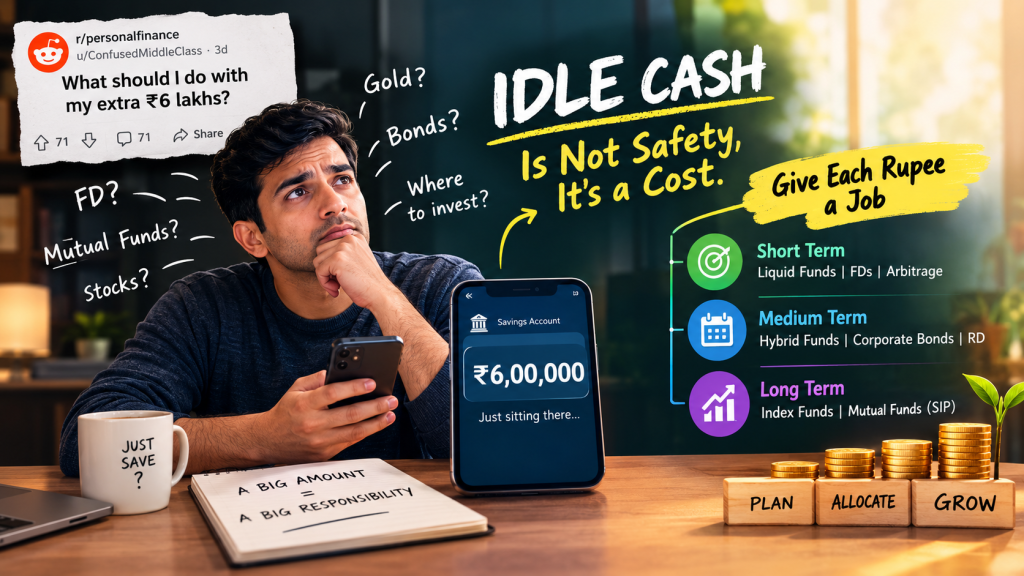
A 33 year old salaried person having a surplus ₹6 lakhs fund in his savings account just posted on reddit for suggestions on how to use that additional funds . He got 71 replies , which probably got him confused . Almost everyone gave him suggestion regarding the ways he should utilize those funds but no one asked him “why did he have those huge leftover funds in his account ?
1) “Safe” Feels Safe but Loses Silently
Savings account may provide 3-4% interest while the inflation is 6-7% . So your real return is literally negative , this is a psychological trap because the balance might have been increasing but the purchasing power has reduced drastically .
2) “I will decide later ” tax
Majority of middle class tend to keep their money in idle condition primarily because of their inability to take decision . Every month he delays investing , he pays an opportunity cost . For an example , if a person with a surplus ₹6 lakhs rupees , had kept his capital in an investment product giving an annual return of 10% , he could have earned an additional ₹60,000 but he could not because he did not make a decision quick enough .
3) Idle Money becomes a temptation
Middle class people tend to be tempted to spend or splurge when they have a big amount like ₹6 lakhs in their account . They even begin to justify their action which often disrupts their investment and saving discipline , this eventually creates instability in their retirement plan.
4) There is a difference between Emergency fund and idle fund
As mentioned before this person already has an emergency fund but he may have subconsciously opted for larger cash cushion but that cushion has no literal purpose other than just lying in his savings account . This is nothing but a pure case of capital misallocation . That excess capital that remains outside the investor’s intended framework, reduces the capital productivity by deviating from the risk to return profile of the total financial plan.
5) Fear of losing vs Fear of missing out
The ₹6 lakhs may have also been lying their not because of cash-management problem but due to a fear problem . The fear of losing his money makes him avoid the investment whereas the fear of missing out makes him look for the “right” investment . This results is ambiguity , he has enough confidence to accumulate what is required but is hesitant to put it under test .
6) Diversification without planning is just confusion
Just by considering different investment instruments like mutual funds , fd, bonds , stocks , gold does not complete the diversification process . Each asset class needs to have its own target weight , purpose ,allocation limit . if these parameters are not defined then you could end up with an issue of idle cash lying around in the savings account . This is a case of asset allocation and capital deployment problem .
Also checkout : 5 Ways Skipping Car Maintenance Can Hurt Your Finances
What he should have done instead ?
Now , this would depend upon the time horizon and the risk appetite
1) Short term
a) Liquid /debt mutual funds
It gives slightly better returns than an FD (6-7%), it is safer and less volatile than the equity mutual fund but the returns are not guaranteed as in FDs. The biggest advantage is that in case of urgent requirement , you can receive the money in your account on T+1 days after requesting for redemption .
b) FDs
As discussed above , it offers fixed returns (5 to 6.5%) and has zero volatility since it is unaffected by market volatility . You can break your FD prematurely if you want it for some emergency . The redemption amount gets back into your bank account usually on the same day or a day after you redeem it .You also get DIGC backed insurance up to ₹5 lakhs per depositor per bank, including interest and principal .
Also check out: 7 Insurance Related Mistakes Middle-Class Indian Families Make
c) Arbitrage fund
This fund provides the difference between equity and derivatives market ,which means if a share is at a price ₹100 value and its futures price is trading at ₹101.5 , fund simultaneously takes both positions simultaneously to capture the spread .
Due to this specific feature , its volatility is generally lower , the returns are almost equivalent to Liquid /debt mutual funds but not guaranteed . The liquidity is also quite good and money is transferred into your bank account on T+1 upon normal redemption.
2) Medium term
a) Hybrid/Balanced advantage funds
Hybrid/Balanced advantage funds can be tolerable for medium term goals . It provides you the option to invest in both debt and equity . The fund manager can change your allocation as per your risk appetite and market conditions . For a short time period , losses are possible but for medium term or long term it can fetch you some good profits although the profits are not guaranteed .
Redemption is also quite easy , the money reaches your bank account in T+2 days . The combination of equity and debt provides growth potential and also some cushioning against downside risk .
b) Corporate bonds
Corporate bonds are like loan provided to a company and in return they provide you with fixed returns upon maturity along with the principal amount . Its returns are quite predictable in nature and is relatively better than FDs. But at the same time you cannot ignore the risk of company defaulting on its debt obligations .
c) RD
In RD (Recurring Deposits) , you can deposit fixed amount on monthly basis , on which you earn a predetermined interest rate . It also enhances your investment discipline and monthly savings . The returns are predictable and risk is quite low .
3) Long term
a) Index Funds/Mutual Funds
These instruments are designed primarily for long term investment purpose because investing through SIPs can help reduce the dependence of timing the market and potentially enhancing the benefits of compounding and rupee-cost averaging . These can be highly volatile , in the short time you can even incur losses but if you are looking at a longer horizon ,they can become growth engine for your principal amount . Redemption is also quite easy , money would get credited in T+2 days in your bank account .
Conclusion
The real lesson over here is not about finding the right product but also creating a system where each rupee has a defined job . A large amounts of unplanned cash exists because of improper financial framework not because of lack of investing options . As you get experienced and seasoned , the question in your mind should change from “Where should I invest this money?” to “Which part of my financial plan should this money fulfil?” . You are not always supposed to check for the right instrument but create and repeat your capital allocation process in order to reduce the unnecessary cash drag .


Leave a comment